
Undergrad Opportunities
Join the lab!
Do research on evolution, genetics, physiology, ecology, or ...
Do research on evolution, genetics, physiology, ecology, or ...

Come discover the evolutionary drivers of biodiversity!
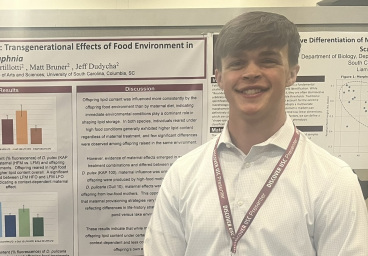
Optimizing methods for lipid assessment in Daphnia
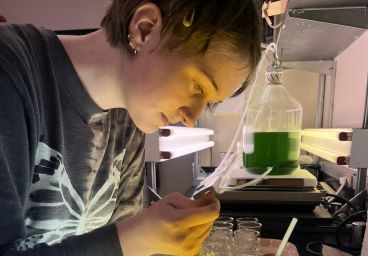
Determining life history effects of environmental calcium.

Modelling the 3-D structure of opsin proteins.

Developing AI tools for evolutionary genetics education.

Our very own algae god and equipment engineer.

Genetic variation of spider venoms and silks.

Evolutionary ecology, genetics, and genomics.
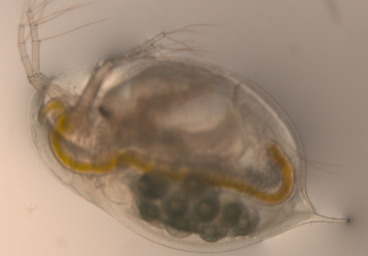
It's all fun and games until someone loses an eye... and then it's Science! We found that eye removal increases egg production in Daphnia. By a lot!
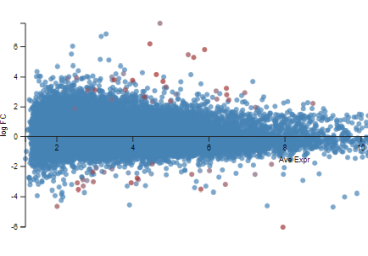
We measured transcriptomes of R. salina in four different light spectra and found a lot of things changed (sex genes lit up in blue light!), but weirdly not photosynthesis genes.
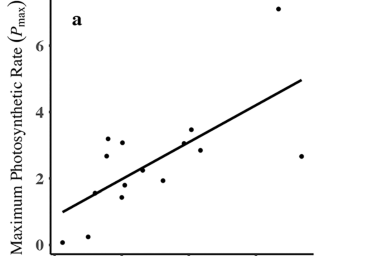
We measured photosynthetic function (PE curves and RLCs) in Cryptophytes, and used phylogenetic comparisons to find a surprising positive correlation of functions across species.
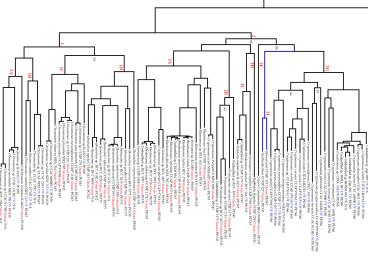
We reconstructed the evolutionary history of the phylum Cryptophyta using the nuclear, nucleomorph, and plastid genomes. And discovered the taxonomy is a mess. Shocker.
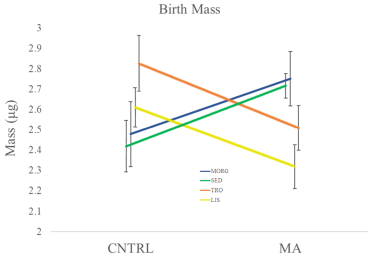
We used long-term experimental evolution via mutation accumulation to explore how mutation influences a critical life history trait goverened by tradeoffs.
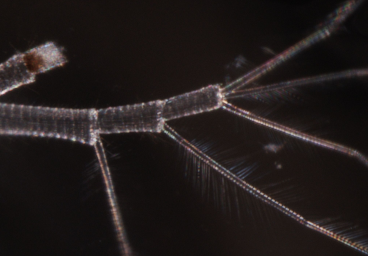
Our collaboration with the Patel lab continues to grow new appendages. Here, we find that short-lived Daphnia have better regeneration than do long-lived Daphnia.
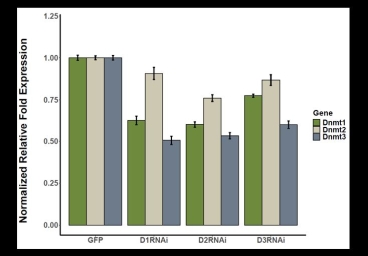
We tried using RNAi-by-feeding to knockdown DNMT expression. It didn't quite work. But we did learn DNMT regulation involves cross-talk among the three DNMTs.
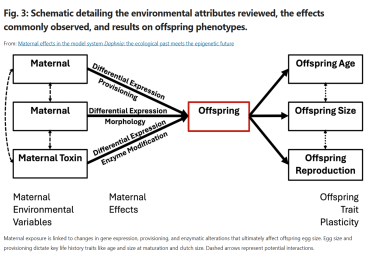
We reviewed biotically driven maternal effects in Daphnia and found that much of what happens involves offspring size. But materials and information also matter.
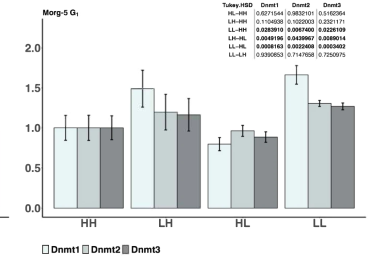
Maternal diet influences expression of all three DNA methyltransferases in offspring, especially if offspring have a poor diet.
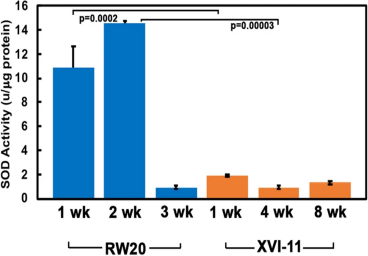
Short-lived Daphnia have reduced mitochondrial complex I activity, increased oxidative damage, and heightened expression of ROS scavenger enzymes.
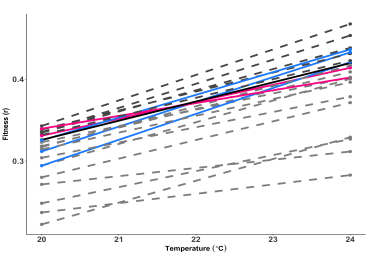
Led by UG Libby Davenport, we tested the hypothesis that elevated temperatures amplify the deleteriousness of mutations. TL;DR: It doesn't.
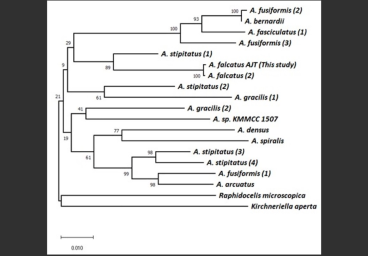
We built a reference transcriptome for our lab algae, Ankistrodesmus falcatus, and estimated relationships among the Selenastraceae.

We used phylogenetic comparisons to show that diversification of total light capture in Cryptophytes is associated with phycobilin concentration and type -- not chlorophyll or size.

Led by Shannon Beston of UT-Arlington, we explored how fish predation influences eye size in Daphnia ... and the main effects turned out to be transgenerational plasticity.

We quantified absorption spectra, pigment concentrations, and light capture in dozens of species of cryptophytes. One surprise: phycobilins could be almost all or almost none of the pigment present.

We traced the the opsin gene family in Daphnia back to the Mesozoic era and found that ancient Daphnia already had many opsins -- and they were probably functionally diverse.

We built a Contraption, demonstrated that Daphnia have an optomotor response, and used it to quantify their visual acuity. Turns out vision may help them avoid fish.

We quantified global methylation in Spartina, testing whether epigenetic dysregulation increased susceptibility to environmental stress. Probably not — but we did find interesting age-dependent patterns.

We measured the reproductive selection gradient on eye size in a population of Daphnia obtusa. We found directional selection favoring larger eyes that was stronger than the selection on body size.

We show that knocking down the gene Sir2 in Daphnia has comparable effects to those in other organisms. This is the first demonstration of a gene affecting life history in Daphnia.

In a collaboration with the Shaw and Lynch labs at IU, the genomes of some of our long-term MA lines were sequenced -- showing that gene conversion and large indels are startlingly frequent.

Using a clone that produces a melanic carapace in response to UV light, we developed an easy protocol for knocking down any gene in adult Daphnia. No microinjections required!

We show that evolved differences in Daphnia longevity cannot be explained by the telomere hypothesis of aging. Short-lived Daphnia have longer telomeres, and maintain them better as they age, than long-lived Daphnia.

A collaborative project led by the Schaack Lab demonstated that the distribution of effects of sponteous mutations varies across ecologically important environmental gradients.

Macroevolutionary patterns suggest that eye size evolves in response to light availability. Does phenotypic plasticity of eye size follow the same pattern? No. But it is plastic with respect to resources, and resource limitation may reduce visual capability by >30%.

We show that the heat shock response is age-dependent, and is more robust in longer-lived Daphnia. This is mediated by age-dependent degradation of transcription factor binding capacity.

Resveratrol has been advanced as a potentially universal way to extend lifespan without costs. However, we found limited evidence for lifespan extension and substantial suppression of reproduction in Daphnia.

Recombination through sexual reproduction is thought to be an important mechanism for purging the load of deleterious mutations in populations. Thus rare sex may lead to accelerated aging, if that means mutations with age-specific effects accumulate. Our results suggest this hypothesis is wrong.

We sought to identify genes that may be involved in adaptive divergence into different resource environments. Using a novel experimental design, we were able to identify genes associated with ecotypic differences in the response to resources.

We examined genetic correlations of life history traits in populations that differ in sex frequency to test alternate mechanisms that could cause the correlations. Our results are best explained by correlated selection that is enhanced by frequent sex.